Most beginner guitarists have the misconception that pedals are overpriced boxes that aren’t necessary when it comes to honing your skills. While expensive boutique brands do exist, and practice is definitely what makes perfect, there also exists a plethora of affordable gear that will expose you to limitless combinations of sounds – essential tools that will help shape your guitar tone and train your musical ear. We’ll be explaining 3 basic types of pedals that will introduce you to the wonderful world of stompboxes without breaking the bank.
Note: All prices listed are in SGD (Singapore Dollars).
1. Dirt/Drive
Dirt/Drive pedals can be split into 3 main categories: Overdrive, Distortion and Fuzz. These are the pedals that add grit and texture to your tone, granting you the musical authority to rock out and command the song with soaring lead solos or beefy chord strums. So what’s the difference between overdrive, distortion and fuzz? Here’s a more technical answer:
“Basically, overdrive, distortion and fuzz are all just references to how hard the signal is clipping. Overdrive will be soft clipping, Distortion will be harder clipping, and Fuzz will be square wave (very hard clipping).”
Brian Wampler of Wampler Pedals
If that was a little too incomprehensible, here’s a more informal answer, courtesy of this Youtube comment:
“Distortion sounds like Chunka Chunka – Fuzz sounds like BSZZT BSZZT –Overdrive sounds like the clean note… but with hair around it.”
Bennett Music Labs
That just about sums it up, but just in case you want to learn more, you can check out these informative videos on the subject:
So now let’s explore these dirt pedals and reveal our inexpensive picks!
Overdrive: Ibanez TS7 – $80
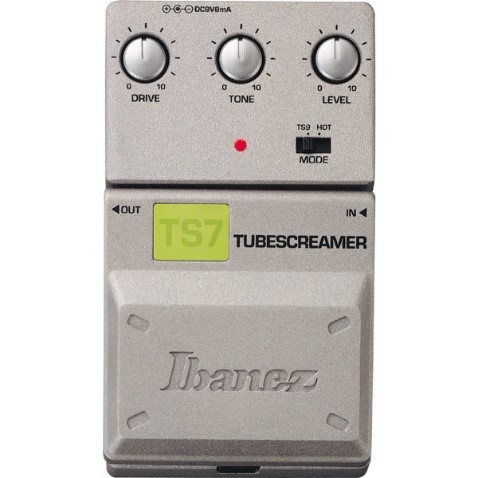
First off, we have the tamest, “cleanest” form of drive: Overdrive. Simply put, the term refers to the sound made by a guitar amplifier that’s been cranked up to such high volumes that your signal begins to distort, as the amplifier has been pushed past its “clean” threshold. This applies mainly to tube amplifiers due to the nature of the tube amp design – producing cleaner sounds at low volumes and distorting as the amp increases in volume. As such, overdrives tend to sound less abrasive than distortion or fuzz pedals, retaining more of the characteristics of your original guitar tone and highlighting the intricacies of your playing. It’s no surprise that blues and country players tend to favour this form of drive pedals.
Our overdrive pick is the Ibanez TS7, part of the reputable and cost-friendly Tone-Lok Series. In case you didn’t know, the Ibanez TS808 and TS9 Tube Screamer pedals are perhaps THE most iconic overdrive pedals, seen on the pedalboards of guitar giants such as John Mayer, Joe Bonamassa, and of course, Stevie Ray Vaughn, the man who popularised the little green giant. The only problem? You have to fork up at least $200 and above to purchase them. And that’s where the TS7 steps in. This cheaper version retains the same circuit as its legendary green cousins, just using lighter duty components that make for such a marginal sonic difference that most players tend to prefer the TS7 for its undisputed affordability. Need some convincing? Just check out the following video and hear it for yourself!
What’s more, the TS7 has an additional HOT mode that adds more gain to an already stellar drive signal, turning up the dirt all the way to 11. It goes for $79.99 at Swee Lee and even cheaper on the online second-hand market. An amazing deal for an amazing overdrive indeed.
Distortion: Boss DS-1 – $70
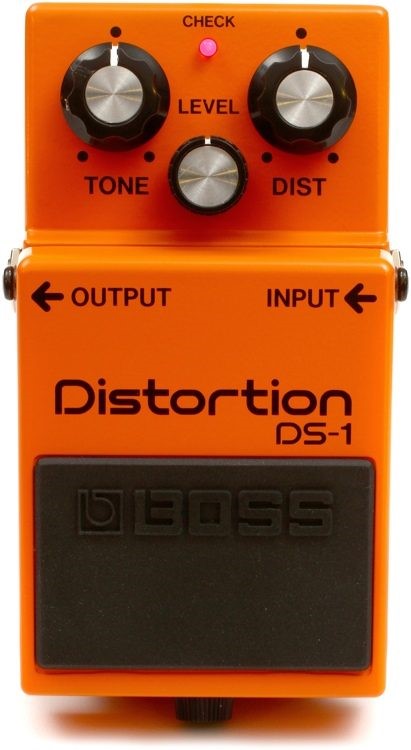
Next we have distortion, the big bad brother to overdrive. Unlike overdrives which sound relatively more transparent, distortions are where things get heavier and gnarlier. Distortions sound more saturated and compressed, power chords sustaining longer than usual. This is why distortions are perfect for more aggressive styles of rock such as grunge, punk and heavy metal.
If aggression is your sound, look no further than the classic Boss DS-1. Used by almost everyone from Kurt Cobain to Steve Vai, this ubiquitous stompbox is one of the best-selling guitar pedals ever due to the versatility of its tone control, being able to dial in bright, searing lead tones that pierce through the band as well as darker chunky rhythm tones that still preserve some clarity. This pedal is no slouch when it comes to delivering the brashness required of a distortion, and at $70 first-hand at places like Swee Lee, you are bound to find cheaper deals on Carousel and the used market.
Fuzz: Donner Stylish Fuzz – $50
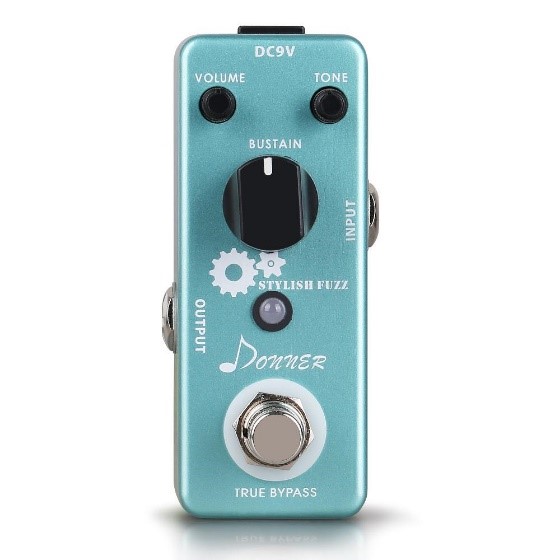
The final member of the drive family is the fuzz. If distortion is the older, naughtier brother of overdrive, fuzz is the big granddaddy of them all, historically being the first type of drive pedal to exist. Fuzzes are a special type of distortion where everything is pushed to sonic extremities. It alters your sound the most noticeably, and is the harshest-sounding harmonically speaking, being likened to a faulty amplifier. But don’t be intimidated, when used correctly fuzzes can provide a harmonic richness to your tone that other dirt pedals can never hope to achieve, offering wild ice-picky textures and crumbly distorted goodness. Just listen to any Jimi Hendrix solo or “I Can’t Get No (Satisfaction)” by the Rolling Stones and get inspired!
Look no further than the Donner Stylish Fuzz when it comes to fuzzes that are a huge bang for your buck. This tiny pedal houses a gargantuan monster of a fuzz that could shake the earth with its huge power. Seriously, at high levels of gain (also known as sustain for some fuzzes), this pedal sounds massive, featuring a miniscule tone knob that dramatically changes the tonal qualities of the fuzz. The tone control is so flexible that this pedal has the potential to sound like 3 different fuzzes with the right settings. While it’s not available locally, you can purchase the pedal directly at Donner’s website. For $50 and free international shipping to boot, there’s no reason to sleep on this mammoth of a fuzz pedal.
2. Delay
Joyo D-SEED Dual Channel Digital Delay – $80 to $95
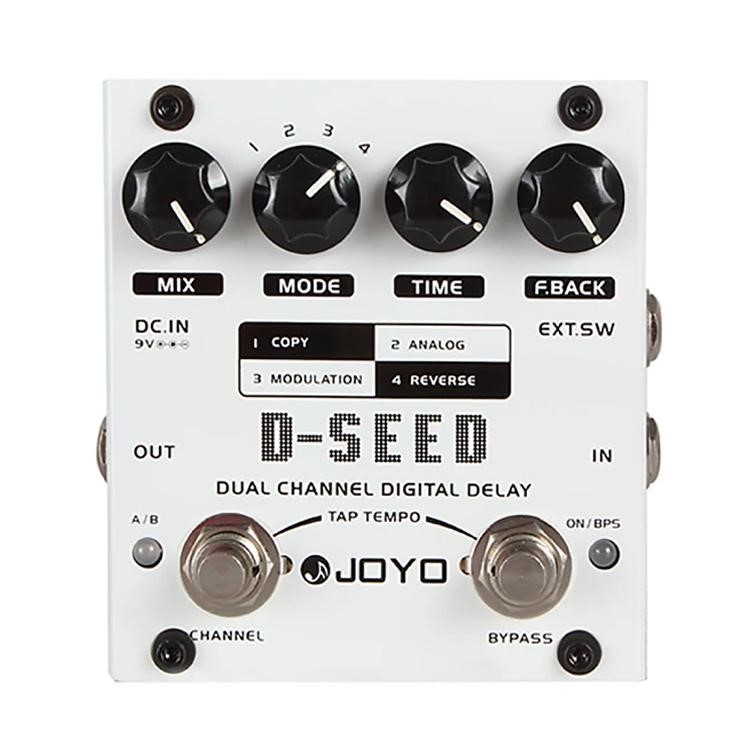
So that does it for our drive pedal picks, now let’s move on to our second type of pedals, Delays. Delay is a time-based effect which records whatever you are playing and plays it back to you once or several times, after a certain period of time. The main parameters of a delay pedal are Time/Delay and Repeats/Feedback. Time refers to the time it takes for the pedal to play back what you just performed, and Feedback is the number of times your playing is repeated back to you. You can think of it as if multiple guitarists taking turns to mimic the notes you play after you perform them. The number of guitarists would then be the Feedback, with Time being the time between your playing and the first guitarist’s duplication.
With these controls, it’s easy to see how versatile of an effect delay is, and the Joyo D-SEED Dual Channel Digital Delay only opens up more sonic possibilities with its 4 unique modes and straightforward layout. Mode 1 captures the crystalline repeats synonymous with digital delays, while Mode 2 captures the warmer, darker, delayed notes that older analogue bucket-brigade device delays are famous for. Modes 3 and 4 feature sounds that are comparatively more experimental, with Modulation giving the delayed notes a clean shimmer effect and Reverse mode – well, doing just that to the repeats. The dual-channel design even permits you to set and save your parameter changes independently, making for easy access to your inventive settings. As if this wasn’t enough, the D-SEED boasts a tap-tempo function on one of the footswitches, a highly popular and useful feature of delay pedals that allow you to freely set the delay time by tapping the footswitch in rhythm to your desired new tempo. It may be hard to come by here, but Amazon, Reverb, and eBay are just some of the alternative online options to snag this gem at a decent price.
3. Reverb
Biyang Tri Reverb RV-10 – $70-$90
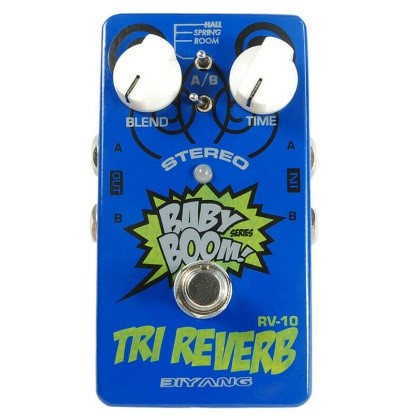
Last, we have reverb. Reverb can be thought of the sound of any physical space. For instance, if you were to clap in a bathroom versus a large stadium, the echoes produced by the sound of that chap reflecting off the walls of those two spaces creates two very different-sounding reverbs. The size of the space as well as the surrounding surfaces all affect the sound of the echoes produced, making every space sounds distinct. It is hence also very different from delay as delay is the repetition of your dry signal while reverb carries information about the interaction between your guitar sound and the environment it’s being played in. Reverb pedals aim to simulate these natural reverbs and other artificially created reverbs too, with the added benefit of letting you customise the echoes to make your guitar sound less bare and more vibrant.
A great introductory pedal to reverb is the Biyang Tri Reverb RV-10, containing 3 prominent reverb models: Hall, Spring, and Room, each with their own A/B mode that differ greatly in tone. The Hall setting emulates the luscious reverb of concert halls, the Spring mode mimics the metallic resonance of a man-made reverb that utilises springs to create the classic “drip” effect, and Room is pretty self-explanatory. Control how loud you want the echoes and the length of their decay with the Blend and Time knob respectively. All in all, it’s an accessible swiss army knife of a reverb that delivers on all fronts, and you can find it easily on sites like AliExpress and Amazon.
And there we have it! Your starter-kit for a set of economical pedals that will get you started on your stompbox journey. Remember that creativity should never come at a hefty price and that your musical instincts are the most valuable asset you have; these pedals only serve as a means to realise those crazy ideas in your head. Go wild and have fun with these stompboxes.
Sources
Brooks, Daniel. “What Does a Reverb Effect Do?: The Basics.” Reverb.com, 2 Mar. 2018, reverb.com/news/what-does-a-reverb-effect-do-the-basics.
Computer Music Specials. “The Ultimate Guide to Effects: Reverb.” MusicRadar, MusicRadar, 14 June 2011, www.musicradar.com/tuition/tech/the-ultimate-guide-to-effects-reverb-461487.
Facundo. “Reverb Vs Delay; Differences and When to Use Them!” The Home Recordings, 27 Feb. 2020, thehomerecordings.com/reverb-vs-delay/.
H., Jared. “Delay & Echo: A Guide to Using Time-Based Audio Effects.” LedgerNote, 15 Feb. 2020, ledgernote.com/columns/mixing-mastering/delay-audio-effect/.
Hoberg, Mason. “The Difference Between Overdrive and Distortion Explained.” Gearank, 27 Oct. 2019, www.gearank.com/articles/overdrive-v-distortion.
Joe. “What Is Delay? A Mini Guide To This Effect.” Studio D: Artist Interviews, Gear Reviews, Product News | Dawsons Music, 9 Nov. 2016, www.dawsons.co.uk/blog/what-is-delay.
Joe. “What Is Reverb? A Mini Guide To One Of The Most Common Effects.” Studio D: Artist Interviews, Gear Reviews, Product News | Dawsons Music, 26 Feb. 2019, www.dawsons.co.uk/blog/what-is-reverb.
Keeley, Ethan. “What’s the Delay? 5 Delay Types and Their Applications.” Mastering Box, 20 Oct. 2017, www.masteringbox.com/delay-types/.
MasterClass. “Guitar 101: What Is a Delay Pedal? Learn How a Delay Pedal Works for Electric Guitar Effects – 2020.” MasterClass, 9 Oct. 2019, www.masterclass.com/articles/guitar-101-what-is-a-delay-pedal-learn-how-a-delay-pedal-works-for-electric-guitar-effects#what-does-a-delay-pedal-sounds-like.
MasterClass. “Guitar 101: What Is the Difference Between Overdrive, Distortion, and Fuzz? – 2020.” MasterClass, MasterClass, 22 Oct. 2019, www.masterclass.com/articles/guitar-101-what-is-the-difference-between-overdrive-distortion-and-fuzz#what-is-the-difference-between-overdrive-distortion-and-fuzz.
Trau, Joseph. “WHAT IS DISTORTION, ANYWAY?” Lifestyle Dunlop, 14 Mar. 2017, lifestyle.jimdunlop.com/the-dunlop-distortion-guide/.
Pearsall, Ken. “Effects Guide: What Is Reverb?” Fender Guitars, 7 June 2019, www.fender.com/articles/tech-talk/pedal-board-primer-reverb.
Weiss, Matthew. “5 Types of Reverb Explained: Plate, Room, Hall, Chamber & More.” Pro Audio Files, 11 Oct. 2018, theproaudiofiles.com/5-different-reverb-types-explained/.