A home-practice setup should fit both the music you want to work on and the room you actually have. A practice pad, an electronic kit and an acoustic kit do different jobs. The biggest setup is not automatically the most useful first purchase.
If you live in a flat or share your home, consider two questions separately: what will you hear while playing, and what will other people hear or feel through the building?
Compare the three options
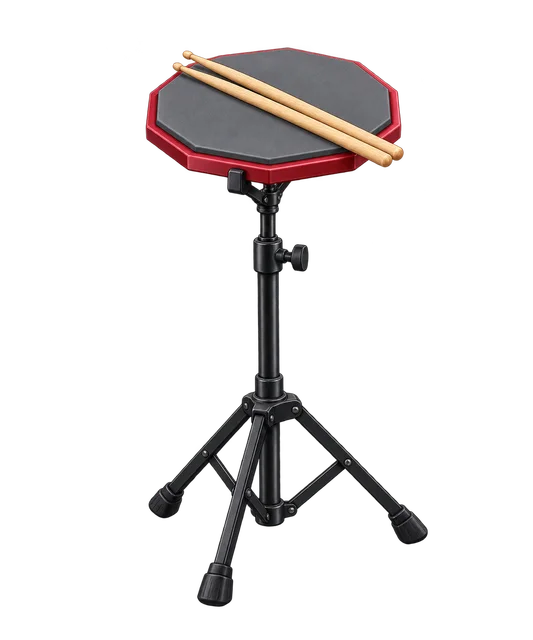
Practice pad
- Useful for
- Focused sticking and rhythm work in a compact space.
- Keep in mind
- One surface is not a full kit or its range of sounds.
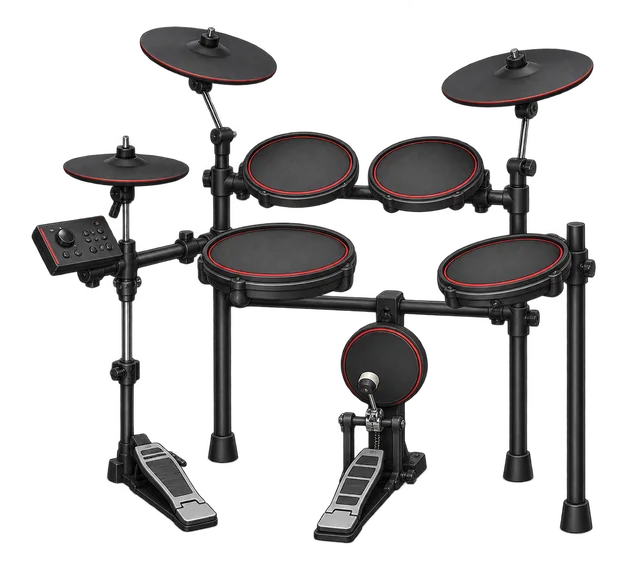
Electronic kit
- Useful for
- Working around pads and pedals, with sound through headphones.
- Keep in mind
- Physical hits and pedal vibration can still be heard or felt.
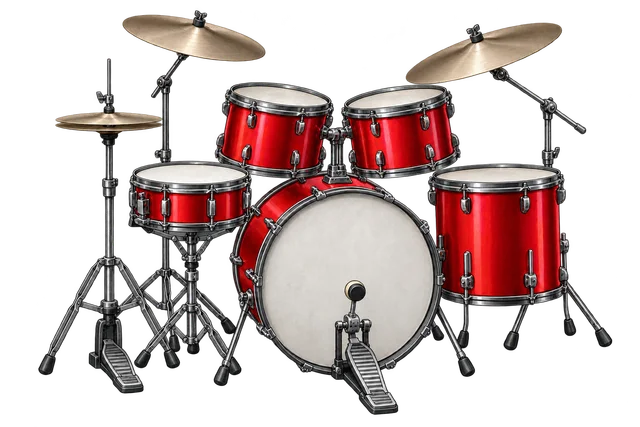
Acoustic kit
- Useful for
- Working directly with drum and cymbal response and sound.
- Keep in mind
- Check room space and playing volume before bringing one home.
The comparison is a starting point for a conversation, not a requirement to buy equipment before enquiring about lessons.
When a practice pad makes sense
A single pad gives you one surface to work on. It can be useful for the sticking patterns and timing tasks you have been given, without arranging a full drum kit at home.
However, a pad does not respond or sound exactly like a drum. Treat pad work as part of learning rather than a complete substitute for time on the instrument. Yamaha’s practice-pad discussion explains why the difference matters.
Ask which exercises suit the pad and which need access to a kit. That makes the purchase decision more specific than simply buying something labelled for beginners.
What headphones do and do not change
An electronic kit lets you listen to its generated drum sounds through headphones. That does not make the physical kit silent: sticks still hit surfaces, and foot pedals can pass vibration into the floor.
Roland’s home-noise guidance notes this issue for its TD-02 kits and explains that vibration-reducing accessories do not guarantee complete elimination.
Before choosing a kit, consider where the pedals will sit and whether the room has people below or beside it. If trying equipment, listen to its physical sound as well as the headphone sound. Do not assume a mat will solve every noise problem.
When to consider acoustic drums
An acoustic kit may suit a space where playing volume and access can be managed. Check room arrangements before bringing one home, rather than treating spare floor space as the only requirement.
Mutes, mesh heads and lower-volume cymbals can change the practice experience. They are not the same as making a room soundproof, and some options change playing feel. Yamaha’s overview of quieter practice options explains the trade-offs.
If your home is unsuitable for a kit, discuss what you can work on there and when you will need access to the instrument elsewhere. Do not assume that learning requires an acoustic kit in every home.
Five questions before buying
- What specific work from my lessons will this setup let me practise?
- Where will I put the equipment, seat and pedals while playing?
- Who shares the space or lives beside or below it?
- Can I try the equipment and hear its physical impact noise?
- What practice will still need access to a full drum kit?
Bring these answers to your equipment conversation. A clear account of your space and learning needs is more useful than choosing by size or appearance alone.
Discuss your next step with AOR
Drum kits are available during AOR lessons; this does not mean students have unrestricted practice-room access outside lessons. Explore AOR’s Drum lessons for current options, fees and enquiry routes, and discuss home equipment before committing to a purchase.